Grok Bot: SpaceXAI launches AI Agent to Counter Claude Cowork’s Success


Set Trending Topics as a preferred source on Google.
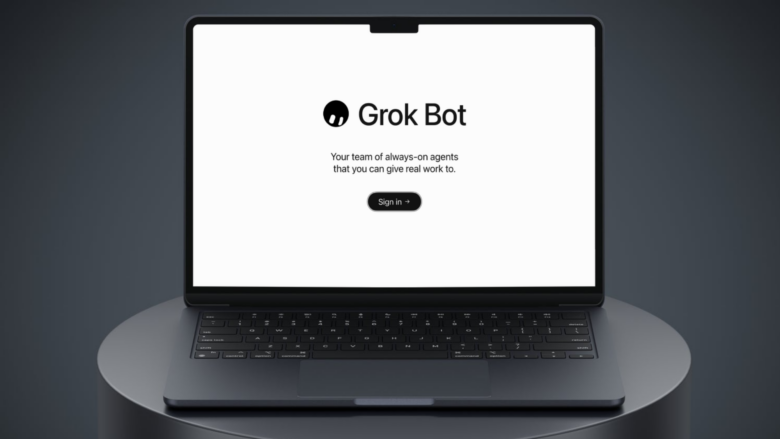
SpaceXAI unveiled “Grok Bot” on Tuesday evening, an agent product the company markets as “AI teammates”. It is the first joint product to come out of the merger of SpaceX/xAI and the AI coding startup Cursor – and an indication that the Cursor brand is likely to disappear in the medium term.
The idea behind Grok Bot: users are meant to hand work to a bot the way they would to a colleague – via chat, without having to configure workflows, automations or routines first. According to the announcement, the bots complete tasks end to end and only come back when something needs approval.
In product logic and vocabulary, this moves SpaceXAI close to Anthropic’s Claude Cowork: that product is likewise about AI agents for general office work rather than coding alone, about tasks that keep running in the background when the laptop is closed, and about switching between desktop and mobile. Cowork launched in January 2026 as a desktop app and was extended to web and mobile in July. In parallel, OpenAI has added Codex to ChatGPT and is working on a “super app” that leans heavily towards B2B.
What makes this awkward is that Anthropic is at the same time one of SpaceX’s largest compute customers. In May 2026, the two companies agreed that Anthropic would use the entire capacity of the Colossus 1 data center in Memphis – more than 300 megawatts and over 220,000 Nvidia GPUs – in part to expand capacity for Claude Pro and Claude Max subscriptions. Anthropic has also expressed interest in SpaceX’s planned orbital data centers. In other words, the group is supplying its product rival with the infrastructure its models run on – a constellation that is becoming increasingly common in today’s AI market.
A computer of its own in the cloud
Technically, the key difference from conventional chatbots is that, according to SpaceXAI, every bot has a computer of its own in the cloud. On it, the bot signs into the tools a team already uses and works across apps, inboxes and websites – explicitly including places where there is no clean API or MCP integration. Because the environment runs in the cloud, tasks are meant to keep going when users close their laptops.
As internal examples, the company cites a sales bot that updates CRM entries from call transcripts and prepares follow-ups, an ops bot that onboards new employees and processes invoices received in Gmail, and an engineering bot that reproduces a bug in the product UI, files a ticket and hands the fix off to another bot.
Other advertised features:
- Multiple bots in parallel: Internally, SpaceXAI says it runs several bots at once, often with a “chief of staff” bot coordinating specialists for the inbox, expenses, recruiting or operations. Bots can message each other independently, share context in threads and distribute tasks among themselves in group chats.
- Learning by watching: A bot can follow along while a task is being completed, save the steps as a routine, take in corrections and run the process on its own the next time.
- Memory: The bots are meant to remember earlier conversations, follow up on threads that were dropped and become more proactive over time.
The announcement leans heavily on quotes from the company’s own staff in product, sales, growth, operations and community roles, who report efficiency gains of two to three times. Independent tests or benchmarks on reliability are not yet available.
Availability and pricing
Grok Bot is available immediately in a beta version for desktop and iOS – but only for subscribers on the upper tiers: SuperGrok Heavy, Cursor Ultra and Cursor Teams Premium. Enterprise customers can join a waitlist.
The fact that subscriptions from both companies unlock access is the first visible evidence that the product worlds of SpaceXAI and Cursor are growing together.
The corporate background: from xAI to SpaceXAI
Following its merger with SpaceX, Elon Musk’s AI company xAI has operated under the name SpaceXAI since July 2026; the Grok model brand was retained. In June 2026 – a few days after the SpaceX IPO – the acquisition of Cursor developer Anysphere for 60 billion US dollars in stock was announced, the largest purchase of a startup to date. According to reports by The Information, the closing was recently said to be imminent, with Musk saying “almost all” regulatory hurdles had been cleared.
For Cursor’s staff, that means being folded into SpaceXAI teams. According to those reports, it was also communicated internally that the Cursor name will no longer appear on new products and is to be phased out over the coming months – existing tools such as the Cursor coding assistant are to keep their name for now. Grok Bot, the general-purpose agent product developed under the internal code name “Sand”, is therefore the first product to make this branding strategy visible. According to the sources, the final naming had not been set in stone as of recently.
The difference from OpenClaw: cloud bot instead of a machine at home
The sharpest contrast is with the open-source agent OpenClaw (formerly Clawdbot or Moltbot), which has been popular in developer circles since early 2026 and makes a very similar promise: an assistant you hand tasks to via chat, which executes shell commands, controls browsers, writes emails and edits files.
The central difference lies in where the agent runs and where its data sits:
- Storage location: OpenClaw runs as a self-hosted daemon on your own machine or your own server. Conversations, long-term memory and learned skills sit there as plain Markdown and YAML files in the
~/.openclawdirectory – readable, copyable and deletable by users themselves. With Grok Bot, by contrast, the bot’s “own computer” sits in SpaceXAI’s cloud; memory, routines and the credentials stored in the bots for third-party tools are managed there. - Models: OpenClaw is model-agnostic and can address both commercial APIs and local open-weight models, for example via Ollama. Grok Bot is tied to the in-house Grok models and to a paid subscription.
- Access and cost: OpenClaw is MIT-licensed, the code can be inspected and forked; costs arise from the models used and your own infrastructure. Grok Bot is a closed product that can currently only be used with the SuperGrok Heavy, Cursor Ultra or Cursor Teams Premium plans.
- Setup: OpenClaw requires basic technical knowledge – installation, hardening and connecting to messengers such as WhatsApp, Telegram, Slack or Signal are handled by users themselves. Grok Bot is installed as an app and operated via chat without configuration.
- Availability: An agent running locally is only online as long as the machine is running – one reason many people run OpenClaw on a VPS. This is precisely where SpaceXAI comes in with its cloud environment, which keeps working even when the laptop is closed.